🎉 Up to 70% Off Selected ItemsShop Sale
Digital Access for Paramedic Flipped Classroom
A first of its kind, the Paramedic Flipped Classroom combines curated content from a variety of market-leading Public Safety Group resources with student-directed activities, including problem-solving exercises, peer-to-peer activities, and student coaching to deliver truly effective and memorable learning experiences.
The flipped classroom model dedicates class time to resolving misconceptions through collaborative problem-solving activities, elevating knowledge into application-level tasks and skills practice, and increasing engagement and confidence. Based on concepts of active learning, student engagement, and hybrid course design, the Paramedic Flipped Classroom serves as a course roadmap to provide a cooperative and successful learning experience.
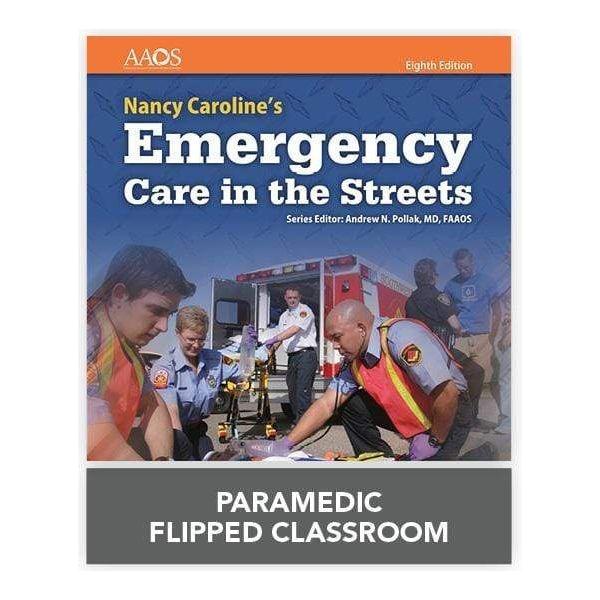
Students interact with primary source content outside of the classroom to develop foundational knowledge. The Paramedic Flipped Classroom delivers primary source content in a variety of engaging formats, including Nancy Caroline's Emergency Care in the Streets, Eighth Edition in paperback and eBook formats, Interactive Lectures, and content from the Virtual Ride-Alongs.
Sample activities include:
- Build It: Students use different objects and materials to build models relating to the lesson topic.
- Problem-Based Learning (PBL) Cases: Students review patient cases that require critical thinking to arrive at the correct diagnosis and patient intervention.
- Challenge Scenario: Students act out a complex scenario that contains multiple issues and requires strong problem-solving skills.
- Simulated patient experiences: Students appreciate what it’s like to experience various conditions, such as schizophrenia, sensory or communication deficits, geriatric mobility difficulties, and more.
- Wrecking Ball: Students create models of wrecking balls to demonstrate the principles of kinesthetics and determine how those principles apply to vehicle crashes and other mechanisms of injury.
- Simon Says: Students take turns being Simon, using medical terms to direct their classmates’ movements.
Paramedic Flipped Classroom helps instructors shift away from the role of lecturer, allowing traditional instructor-centered classrooms to transform into student-centered learning environments where instructors can have an even greater impact on student outcomes.
$556.93
Original: $1,856.44
-70%Digital Access for Paramedic Flipped Classroom—
$1,856.44
$556.93Product Information
Product Information
Shipping & Returns
Shipping & Returns
Description
A first of its kind, the Paramedic Flipped Classroom combines curated content from a variety of market-leading Public Safety Group resources with student-directed activities, including problem-solving exercises, peer-to-peer activities, and student coaching to deliver truly effective and memorable learning experiences.
The flipped classroom model dedicates class time to resolving misconceptions through collaborative problem-solving activities, elevating knowledge into application-level tasks and skills practice, and increasing engagement and confidence. Based on concepts of active learning, student engagement, and hybrid course design, the Paramedic Flipped Classroom serves as a course roadmap to provide a cooperative and successful learning experience.
Students interact with primary source content outside of the classroom to develop foundational knowledge. The Paramedic Flipped Classroom delivers primary source content in a variety of engaging formats, including Nancy Caroline's Emergency Care in the Streets, Eighth Edition in paperback and eBook formats, Interactive Lectures, and content from the Virtual Ride-Alongs.
Sample activities include:
- Build It: Students use different objects and materials to build models relating to the lesson topic.
- Problem-Based Learning (PBL) Cases: Students review patient cases that require critical thinking to arrive at the correct diagnosis and patient intervention.
- Challenge Scenario: Students act out a complex scenario that contains multiple issues and requires strong problem-solving skills.
- Simulated patient experiences: Students appreciate what it’s like to experience various conditions, such as schizophrenia, sensory or communication deficits, geriatric mobility difficulties, and more.
- Wrecking Ball: Students create models of wrecking balls to demonstrate the principles of kinesthetics and determine how those principles apply to vehicle crashes and other mechanisms of injury.
- Simon Says: Students take turns being Simon, using medical terms to direct their classmates’ movements.
Paramedic Flipped Classroom helps instructors shift away from the role of lecturer, allowing traditional instructor-centered classrooms to transform into student-centered learning environments where instructors can have an even greater impact on student outcomes.